
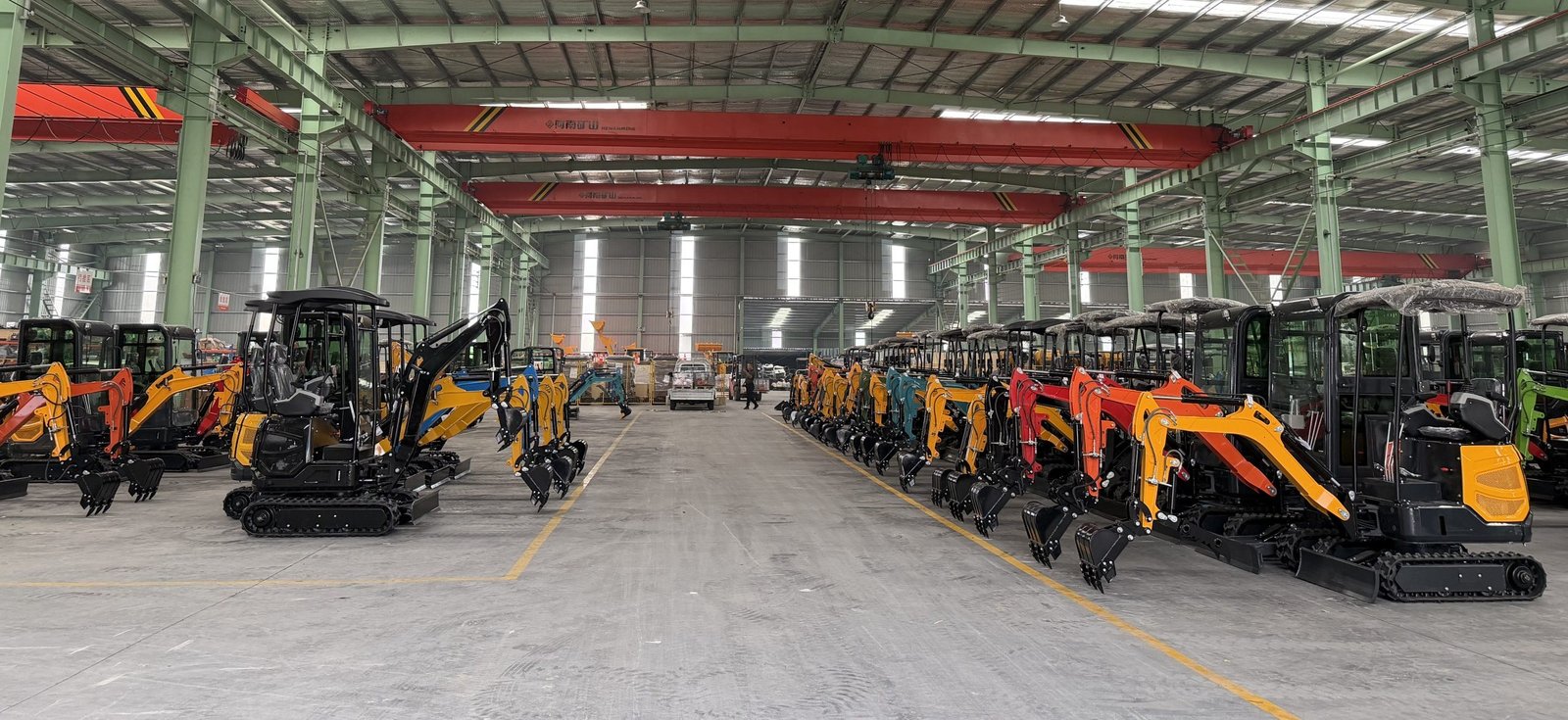
Excavators are the workhorses of the construction industry — and China is now the world's largest producer of them. From compact 0.8-ton mini excavators to 90-ton mining shovels, Chinese manufacturers offer a model for virtually every job site and budget. For B2B buyers in Africa, the Middle East, South America, and Southeast Asia, importing an excavator from China typically delivers cost savings of 30-50% compared to equivalent Japanese or European machines, without sacrificing the reliability that modern Chinese brands now provide.
But importing an excavator is not as simple as clicking "buy." It involves selecting the right size and brand, vetting a supplier, negotiating shipping terms, clearing customs, and planning for spare parts. This 9-step guide walks you through the entire process so you can import your next excavator with confidence and avoid the costly mistakes first-time buyers make.
Whether you need a single mini excavator for tight urban jobs or a fleet of large crawler excavators for earthmoving, the fundamentals below apply to every purchase.
Before you talk to any supplier, you must know exactly what kind of excavator your project needs. Excavators are classified primarily by operating weight, which determines digging power, transport requirements, and price. Choosing the wrong class is the most expensive mistake a first-time buyer can make.
Size classes at a glance:
| Class | Operating Weight | Typical Use | Transport Note |
|---|---|---|---|
| Mini | 0.8 - 8 tons | Landscaping, utility trenches, indoor demolition, small farms | Fits in a 20ft container; towable by pickup |
| Small / Compact | 8 - 15 tons | Urban construction, road repair, foundation work | 1 unit per 40ft container (disassembled) |
| Medium | 15 - 25 tons | General earthmoving, excavation, loading trucks | Flat-rack or container; heaviest single units |
| Large | 25 - 50 tons | Mining, quarry, large-scale infrastructure | Flat-rack, breakbulk, or RoRo shipping |
Two key configuration choices:
- Crawler vs. wheeled — Crawler (tracked) excavators offer superior stability and flotation on soft ground; wheeled excavators move faster between sites on paved roads and need no transport trailer. See our HT45 wheeled excavator for a 4.5-ton wheeled option.
- Standard vs. long-reach vs. zero-tail — Long-reach booms for dredging/demolition, zero-tail swing for confined spaces. Match the boom to your primary task.
China has several world-class excavator brands, each with different strengths, price points, and parts ecosystems. Selecting the right brand depends on your budget, required durability, and local parts availability.
| Brand | Positioning | Best For | Price Tier |
|---|---|---|---|
| XCMG | Largest Chinese OEM; full range | All classes; strong export network | Mid - High |
| SANY | Global tier-1; premium quality | Medium-large; high-resale markets | High |
| SDLG | Volvo-tech; value focus | Medium earthmoving fleets | Mid |
| LiuGong | Durable; emerging globally | Mining, heavy applications | Mid |
| Lovol / Zoomlion | Competitive pricing | Cost-sensitive fleets | Low - Mid |
| Hightop (HT series) | Specialist mini excavators | 0.8-9t mini & compact | Low - Mid |
For mini and compact classes, the Hightop HT35 and HT60 crawler excavator are popular choices for their Kubota/Yanmar engine options and widespread parts availability. For mid-to-large classes, XCMG and SANY dominate the export market. Compare models side by side on our Shop by Brand page.
You can buy directly from a factory or through a specialized trading/export company. Both models work, but they carry different risks and benefits. A trustworthy partner handles export documentation, inspection, and shipping — the parts of importing that cause the most headaches.
| Aspect | Direct from Factory | Export Trading Company |
|---|---|---|
| Price | Lowest (no middle layer) | Slightly higher (service fee built in) |
| Multi-brand | Single brand only | Multiple brands — easier comparison |
| Export expertise | Varies; sales-focused | Specialized in documentation & logistics |
| After-sales | Direct but slower | Coordinated single point of contact |
Verify before you commit:
- Business license & export license — request copies; confirm with official registries where possible
- Reference customers — ask for contacts in your region who already imported from them
- Physical presence — a real office, warehouse, or factory you (or an inspector) can visit
- Communication quality — responsive, technical, and transparent about limitations
Refusal to provide a business license, pressure for full payment upfront via irreversible methods, no verifiable export history, or prices dramatically below market. If a deal feels too good to be true, it usually is.
Always request quotes in writing with a clear breakdown. The headline price is only part of your cost — understanding the shipping term is critical.
| Term | Who Pays Freight/Insurance | Best For |
|---|---|---|
| EXW (Ex Works) | Buyer arranges everything from factory | Experienced importers with own logistics |
| FOB (Free On Board) | Buyer pays sea freight & insurance | Most common; you control shipping |
| CIF (Cost, Insurance, Freight) | Seller pays to your port | Beginners wanting one invoice |
| DDP (Delivered Duty Paid) | Seller pays to your door incl. duties | Maximum convenience; highest price |
Compare at least 2-3 suppliers on the same Incoterm and same specifications — otherwise you are comparing apples to oranges. Beyond price, weigh warranty length, spare parts inclusion, and the supplier's track record.
Never ship an excavator you have not verified. Pre-shipment inspection catches problems while the machine is still in China, where the supplier has incentive and ability to fix them.
Pre-shipment inspection checklist
- Match serial number, model, and specification to the contract
- Verify engine brand, model, and emission standard (CE/EPA/ISO)
- Operational test: start, idle, full-range boom/swing/travel cycles
- Check hydraulic cylinders for leaks; verify 27-28 MPa system pressure
- Inspect undercarriage: track tension, roller wear, shoe condition
- Confirm bucket/counterweight/attachment match the order
- Photo & video documentation of every angle, including the chassis plate
- Request third-party inspection (SGS, BV, Intertek) for large orders
Confirm the machine carries the certifications required by your destination market. Many excavators are built to CE (Europe), EPA (North America), or ISO standards; some markets additionally require PVOC, SONCAP, or SASO pre-export certificates. Arrange these before the machine leaves China.
Use secure, traceable payment methods and a written contract. The standard practice for B2B machinery imports is a deposit with balance before shipment.
- T/T (Telegraphic Transfer) — 30% deposit + 70% against copy of Bill of Lading is the industry norm
- Letter of Credit (L/C) — safer for large orders; bank guarantees payment against compliant documents
- Trade Assurance platforms — escrow-style protection on marketplace orders
Your contract should specify exact model, specifications, color, attachments, warranty terms, inspection rights, and penalty clauses for late or non-compliant delivery. Never rely on chat messages alone for the final agreement.
Excavators are transported by sea. The right method depends on machine size and your budget.
| Method | Best For | Notes |
|---|---|---|
| Container (20ft/40ft) | Mini & small excavators (up to ~15t) | Cheapest; 1-2 units per container, often disassembled |
| Flat-rack | Medium-large excavators | Machine secured on open platform; weather exposure |
| RoRo (Roll-on/Roll-off) | Self-propelled, operational machines | Fast loading; limited routes & ports |
| Breakbulk | Oversized / very large units | Most flexible; highest handling cost |
Request loading photos and the container/seal number. Typical transit times: East Africa 25-35 days, West Africa 30-40 days, Middle East 18-28 days, South America 35-48 days, Southeast Asia 8-18 days. Your supplier should provide a tracking link within days of sailing.
Excavators are generally classified under HS code 8429.52 (self-propelled, full-rotation, crawler-type). Confirm the exact code with your customs broker — misclassification is a common cause of hold-ups and penalties.
Required import documents:
| Document | Purpose & Notes |
|---|---|
| Bill of Lading (B/L) | Proof of ownership and transport contract; must match invoice |
| Commercial Invoice | Transaction value for duty calculation; include HS code & terms |
| Packing List | Weight, dimensions, contents of each package |
| Certificate of Origin | May qualify for preferential tariff under FTAs (e.g., ASEAN-China Form E) |
| Inspection Certificate | Required by some countries (Kenya PVOC, Nigeria SONCAP, Saudi SASO) |
| Import Permit / License | Some countries require a permit for heavy machinery |
Typical import duty rates (excavators):
| Region / Country | Import Duty | VAT / GST |
|---|---|---|
| East Africa (Kenya, Tanzania) | 0-10% | 16-18% |
| West Africa (Nigeria, Ghana) | 5-15% | 5-7.5% |
| Middle East (UAE, Saudi) | 5% | 0% / 15% |
| South America (Brazil, Peru) | 10-20% | 16-19% |
| Southeast Asia | 0-5% | 10-11% |
Your relationship with the supplier should continue long after delivery. Plan for maintenance and support before you buy.
- Spare parts package — filters, seals, bucket teeth, and wear items for the first 6-12 months (adds ~5-8% to cost but prevents downtime)
- Warranty — typically 12 months or 2000 working hours; covers major components (engine, hydraulic pump, travel motor), not wear items
- Remote support — WhatsApp/WeChat technical groups, digital manuals, and video-call guidance for repairs
- Assembly — container-shipped units may need boom/bucket reattachment and fluid refill on arrival
Even experienced importers slip up. Here are five costly errors and how to dodge them:
The cheapest excavator often costs more over its life through breakdowns and poor parts support. A 10% higher price from a reputable exporter can save 30%+ in lifetime costs. Evaluate total cost of ownership.
Buyers who skip inspection to save a few hundred dollars often find faults after arrival — when returning the machine is impractical. Always inspect, in person or via a third party.
FOB price excludes freight, insurance, duties, VAT, and inland transport. Your real cost is typically 20-40% higher. Calculate landed cost before committing.
PVOC, SONCAP, or SASO certificates must be obtained in China before shipment. Arriving without them means holds, returns, or penalties at your port.
Downtime costs more than parts. Order a wear-parts kit with the machine and establish an ongoing parts channel so a broken filter doesn't idle your jobsite for weeks.
Since 2017, JINAN ARCHER TRADE CO., LTD has helped B2B buyers worldwide import Chinese excavators and construction machinery with confidence. We represent 9 leading Chinese brands, so you can compare XCMG, SANY, SDLG, Lovol, and the Hightop mini-excavator series side by side — all from one accountable supplier.
What every buyer receives:
- Full export documentation — invoice, packing list, B/L, certificate of origin, and destination-specific certificates (PVOC, SASO, SONCAP)
- Pre-shipment inspection — photos, videos, and operational test reports for every machine
- Flexible shipping — FOB, CIF, or DDP; container, flat-rack, RoRo, or breakbulk
- OEM customization — colors, logo branding, attachments, and spec adjustments
- Spare parts & warranty — maintenance kits and 12-month warranty with remote technical support
- Multilingual team — English, Spanish, French, Russian, and Arabic
Explore our full range on the products page or learn more about our company.
Conclusion
Importing a Chinese excavator is a proven way to cut equipment costs by 30-50% while accessing a mature, rapidly improving manufacturing base. The process comes down to nine steps: define your size and type, choose the brand, find a reliable exporter, compare total cost, inspect quality, finalize payment, arrange shipping, clear customs, and plan for parts and warranty.
The most successful buyers invest time upfront in supplier verification, understand their true landed cost, and never skip quality control. At Archer Machinery, we have spent nearly a decade guiding B2B buyers through every stage — from first inquiry to spare parts years later. If you are ready to import your next excavator, or simply want expert advice on the right model, we are here to help.
Ready to Import Your Next Excavator?
Get a free, no-obligation quote within 24 hours. Tell us your size class and application, and our export specialists will recommend the best Chinese excavator for your project — with transparent pricing and full documentation support.
Need help choosing the right excavator? Visit our products page or contact our team for personalized assistance.